Hi there! My name is Ashley Brookey and I am a senior at CWU studying for my Craft Brewing minor. While my bachelor’s degree is in Biomedicine, I have a passion for understanding how different sciences interact with each other. Currently, I am completing my Craft Brewing Practicum and I have chosen to overlap my project with my job at Ellensburg Brewing Co. & Tilted Tree Cidery where I work as a waitress. My goal is to ensure that customers are satisfied with the products we offer.
I wanted to investigate whether the brewers at Ellensburg Brewing Co. are achieving their intended flavor profiles, and this became the focus of my project. To achieve this, I decided to approach the college students associated with the Craft Brewing department at CWU. The brew master at Ellensburg Brewing Co. has taught and advised many students in the department, making it an excellent choice for my project given the inspiration and motivation of the students.
History of Ellensburg Brewery
The Ellensburg Brewery is a German brewery and restaurant with a rich hundred-year history. It was originally founded as St. Louis Brewing & Malting Company in 1895 and operated under that name until 1907 when it was succeeded by Ellensburg Brewing & Malting Co. until 1915. The company was later re-established as the Ellensburg Brewing Co., Inc. from 1933-1937, and then as Mutual Brewing Co., Inc. from 1937 until 1943. In the 2000s, the business was revived and now strives to preserve the establishment’s history while bringing back older styles of German beer.
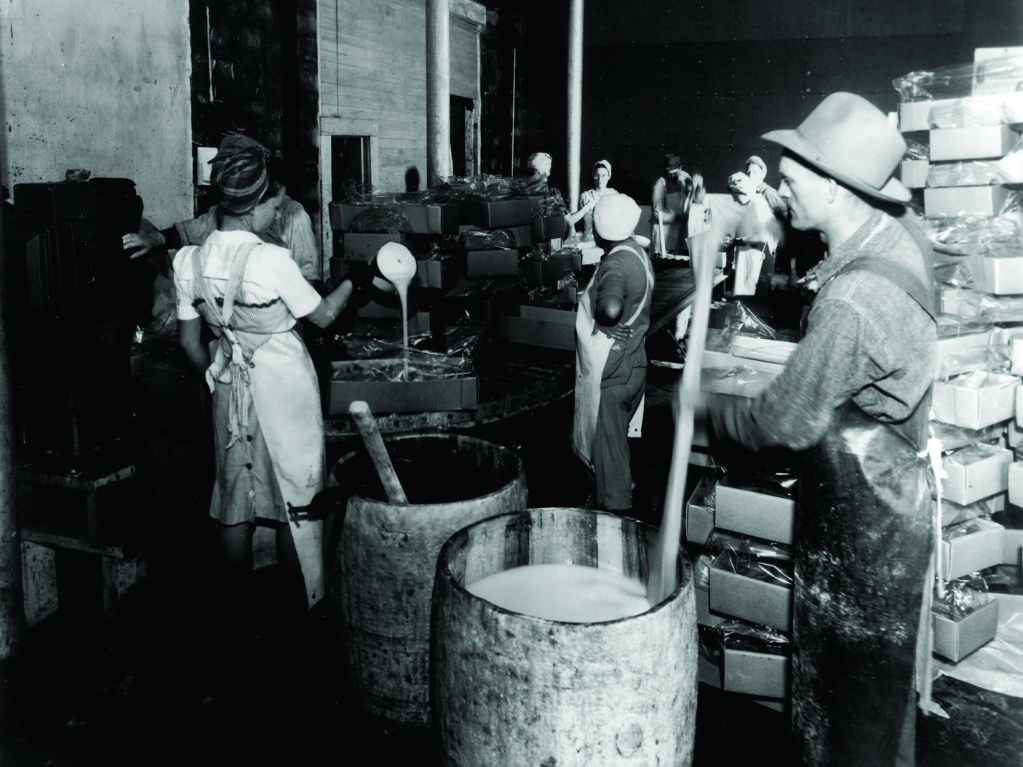
This picture exhibits men and women stirring local product in large barrels, as a part of the Ellensburg Brewery. This picture can be found at The Kittitas County Historical Museum and Ellensburg Brewing Co. & Tilted Tree Cidery.
Beer Styles Chosen for the Project
This project consists of four beer styles: Olde Style Pilsner, Edel-Brau Amber Lager, Eburg IPA, and Dogtown Porter. All of these styles are brewed and sold at the Ellensburg Brewery. I chose these four styles because they are distinct from each other and use different brewing techniques to produce the beer.
Olde Style Pilsner is a light-bodied beer with spicy notes from the Saaz hops used in brewing. Saaz is one of four noble hops and has a low alpha acid percentage, which provides a pronounced herbal aroma and hoppy finish. Saaz also contains elevated levels of polyphenols, which help diminish oxidation and improve the beer’s shelf-life. The Olde Style Pilsner at Ellensburg Brewery is 4.5% ABV and has 33 IBUs. The Brew Masters at Ellensburg Brewery are aiming for a more traditional take on this style by using the traditional hop Saaz.
Edel-Brau Lager is a dark-amber lager style with 5.0% ABV and 23 IBUs. This beer has a caramel sweetness with a well-balanced finish between hoppiness and maltiness. Historically, the term Edel-Brau has been used to describe the highest quality of beer made with the best ingredients. The brewers at Ellensburg Brewery are striving for this beer to have a sweet, malty finish and to preserve the history of older beer styles.
Eburg IPA is a classic American West Coast piney, citrusy IPA with 6.6% ABV and 80 IBUs. The brewers used a 4-part hop blend of Chinook, Cascades, Centennial, and Simcoe to produce this beer, and American Pale and Caramel malts to help balance the finish. This beer is an excellent example of the complexity involved in producing a top-selling beer for a local brewery.
Dogtown Porter is a Baltic Porter with a dark color, smoothness, and cold-fermented Lager yeast. This beer has 6.0% ABV and 28 IBUs. The hops used in making this beer is German Polaris, and the brewers used a combination of malts including Pilsner, Vienna, Munich I, Cara Red, and Cara Munich. Ideally, this beer should have layers of aromas and flavors of chocolate malt and dark, rich fruits.
Overall, these four styles showcase the range of beer styles and brewing techniques used at Ellensburg Brewery.
Project Overview
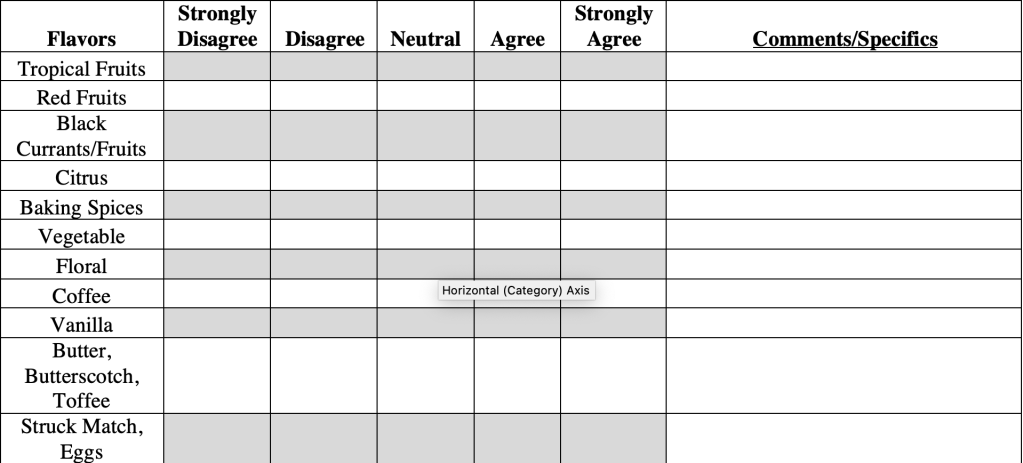
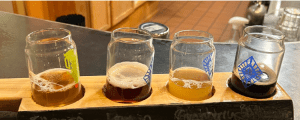
Participants in the blind tasting were given four beers in consecutive order from left to right: Olde Style Pilsner, Edel-Brau Amber Lager, Eburg IPA, and Dogtown Porter. After careful evaluation, each participant, including brewers and students, was given a tasting sheet and asked to rate their perceptions of the beer’s flavor profile on a 5-point Likert scale ranging from 1-5 (Strongly Disagree/Disagree/Neutral/Agree/Strongly Agree), with higher scores representing a greater agreement with the given flavors. The participants were also asked to provide additional comments on each beer, including suggestions for improvement. The given survey for each of the four beers provided looked like:
After the tasting evaluation project was completed, the participants were debriefed on the beers they had sampled. They were provided with information on each beer, including its name, style, and ABV. The feedback gathered from the participants will be used to make improvements to the beers offered at Ellensburg Brewing Co. and ensure that they meet the expectations of their customers.
Study Overview
As a student in the Craft Brew Department at CWU, I have gained a deeper understanding of the brewing process, from the selection of ingredients to the control of fermentation conditions. In addition to my academic studies, I work at Ellensburg Brewing Co., where I have gained practical experience in the brewing industry. One question that interests me is whether the brewers at Ellensburg Brewery are successfully achieving the flavor characteristics they aim for. While the brewers aim to produce beers with specific flavor profiles, such as fruity, malty, or hoppy notes, it is not always clear if these goals of the brewers are being achieved. Taste is subjective, and what one person perceives as hoppy or malty might be different from another’s interpretation. Therefore, I wanted to explore this question further and see if there is a correlation between the brewers’ intentions and the perceptions of their customers.
Given that Ellensburg is a college town, I decided to focus my analysis on college students. College students are an important demographic for the brewing industry, as they are often looking for new experiences and are willing to try new products. I believe that by understanding the flavor preferences of college students in Ellensburg, the brewers at Ellensburg Brewery can create more targeted products that appeal to their customers.
By combining my academic knowledge and working experience, I hoped to gain more of an insight into the brewing process and the factors that affect flavor perception. I planned to use a combination of surveys and taste tests to collect data from college students and the brewers. Ultimately, my goal was to provide useful information that can help improve the quality and appeal of the products produced by Ellensburg Brewery.
Study Proposal
Initially, my plan was to conduct a study with a larger, and more diverse demographic. However, I encountered difficulties in recruiting non-craft brewing students, possibly due to insufficient advertising. In the end, I decided to include craft brewing students and brewers at Ellensburg Brewery in my study. While the findings of this study may not be generalized to a broader population, I believe they can still provide valuable insights into the beer preferences and characteristics of those with some degree of knowledge in the field.
Furthermore, while I had initially planned to assess a wider range of beers, I chose to focus on four key varieties that are popular staples at Ellensburg Brewery. This allowed me to more thoroughly investigate the sensory characteristics and overall quality of each beer. By selecting these four beers, I was able to gain a deeper understanding of the specific factors that contribute to the taste and aroma profiles of these varieties, which could ultimately inform the development of new or improved brewing techniques.
Study Results
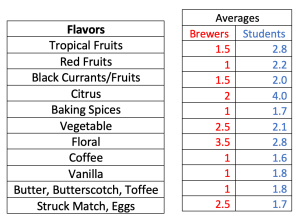
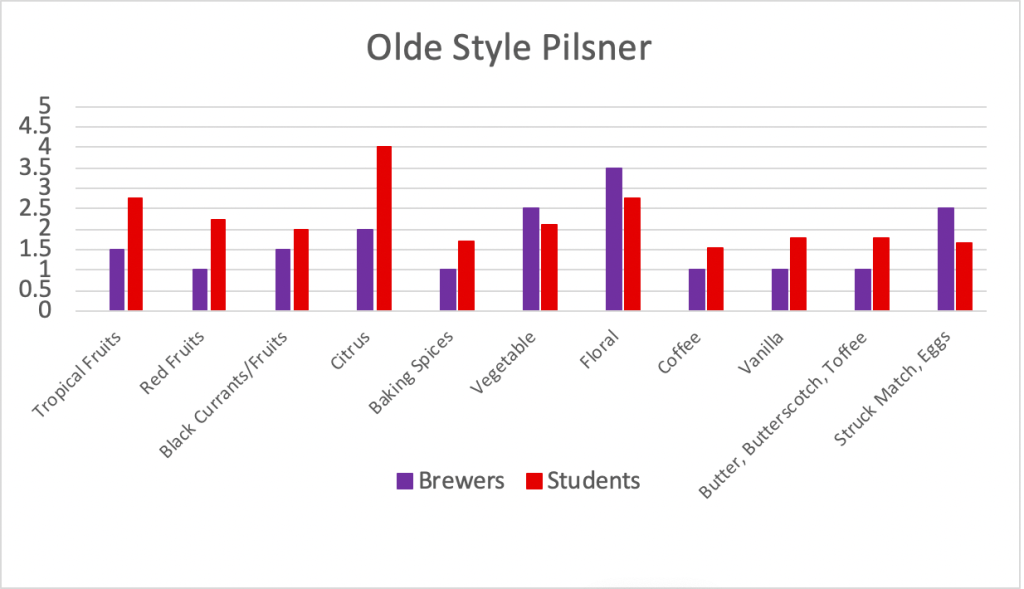

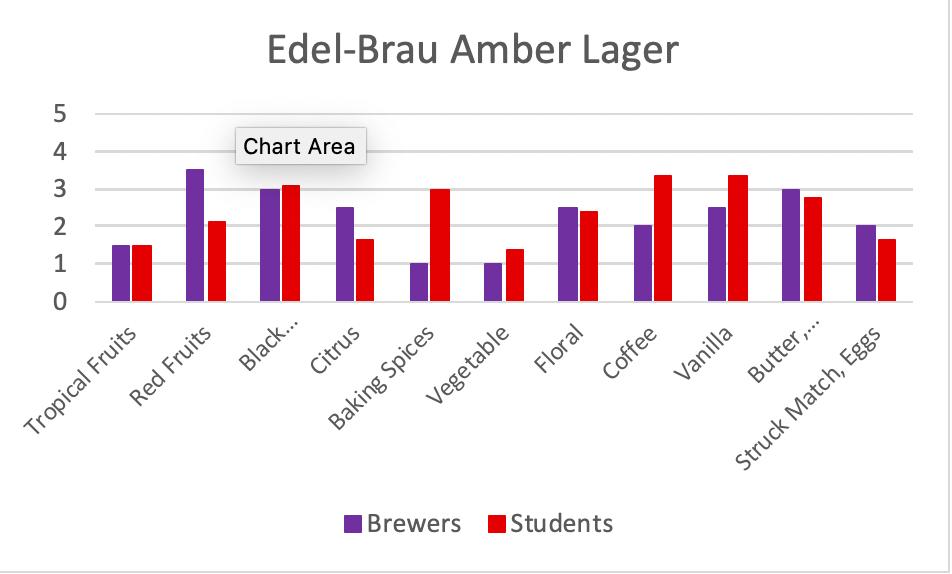
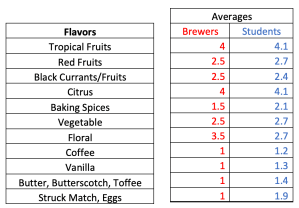
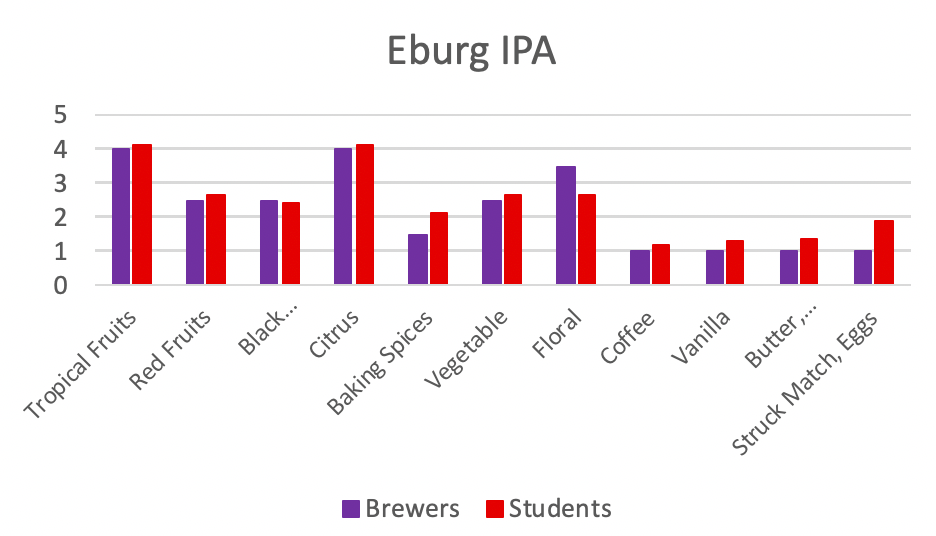

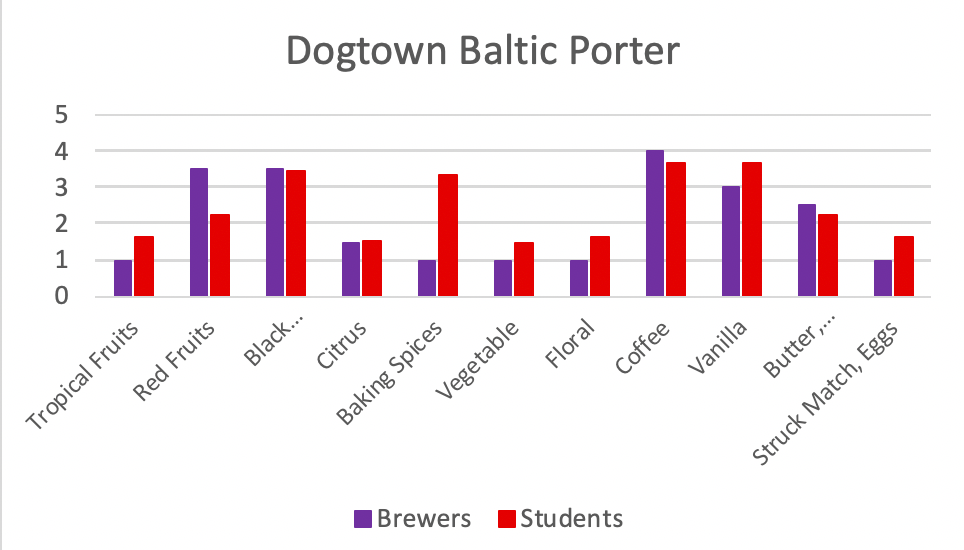
The blind tasting evaluation of the four beers, Olde Style Pilsner, Edel-Brau Amber Lager, Eburg IPA, and Dogtown Porter, was conducted with both the craft brewing students from CWU and the brewers at Ellensburg Brewing Co. Participants were asked to rate their perceptions of the beer’s flavor profile on a 5-point Likert scale ranging from, Strongly Disagree (1) to Strongly Agree (5), with higher scores indicating a stronger agreement with the given flavor profile. The results indicated that the perceptions of flavor profiles varied slightly between the two groups, particularly in the case of the Olde Style Pilsner and the Edel-Brau Amber Lager. The craft brewing students perceived a higher citrus flavor and more tropical fruits in the Olde Style Pilsner compared to the brewers, who assessed the other flavor profiles similarly. The Edel-Brau Amber Lager was perceived to have more baking spices by the students compared to the brewers, whereas the brewers picked up on more red fruits in comparison to the students. The Eburg IPA was rated similarly by both groups, with parallel fruit profiles noted. The Dogtown Baltic Porter was perceived to have more baking spices by the students compared to the brewers, while the brewers detected more red fruits than the students.
Overall, the results suggest that the perceptions of flavor profiles between the craft brewing students and the brewers are relatively similar, with a few variations in individual beers. This may be due to the differences in experience and training between the two groups. The findings suggest that both groups have a good understanding of the flavor profiles of the beers, and this is important for brewers and those studying to become brewers in order to create consistent and desirable products.
In addition, the results highlight the unique flavor profiles of each beer. Olde Style Pilsner was found to have a pronounced herbal aroma and hoppy finish, with a higher citrus flavor and more tropical fruits perceived by the craft brewing students. Edel-Brau Amber Lager was described as having a caramel sweetness with a well-balanced finish between hoppiness and maltiness, with more baking spices detected by the craft brewing students and more red fruits noted by the brewers. Eburg IPA was noted to have a classic piney, citrusy flavor profile, with a complex blend of hops and malts. Finally, the Dogtown Baltic Porter was found to have layers of aromas and flavors of roasted, chocolatey malt and rich, dark fruits.
These findings have important implications for both the craft brewing industry and the study of brewing. The results can be used to inform the brewing process and help brewers create consistent and desirable products. They can also help to inform the education and training of those studying to become brewers, providing them with a better understanding of the flavor profiles of different beers and how to achieve them.
Conclusion
In conclusion, the data reveals that the majority of the craft brewing students and brewers shared similar perceptions of flavor profiles with the provided beers. However, there were slight differences in the way they perceived the Dogtown Porter and Pilsner. Specifically, the students detected more baking spices in the Porter and more citrus flavors in the Pilsner than the brewers did. Despite these disparities, the overall results show no significant difference between the two groups, which suggests that the craft brewing students were adequately equipped with the necessary knowledge and skills to evaluate the beers. Additionally, the brewers seem to have successfully targeted the flavor profiles that resonates with this particular demographic. Overall, the findings of this study provide insight for the craft brewing department and could easily be built on for future research in this area.
Future Work
There are several areas that could be explored in future research pertaining to this study. First, a more comprehensive approach could be taken to gather data from a wider range of participants. While this study focused on the perspectives of CWU Craft Brewing students and the Brew Masters at Ellensburg Brewery, it could be expanded to include non-craft brewing students and members of the general public in the community. This would provide a more diverse range of perceptions and insight of craft beer in Ellensburg.
Additionally, follow-up research could focus on other types of beer that are produced at Ellensburg Brewery. This study analyzed four different varieties: Olde Style Pilsner, Edel-Brau Lager, Eburg IPA, and Dogtown Baltic Porter. However, the taproom offers about 15 different types of beer at a time. Surveying a wider range of beers could help in recognizing factors that contribute to the perceptions people are perceiving, and aid in giving the college students and locals what they want.
Overall, there are many opportunities to build on from this study, as well as expanding our understanding of the craft beer culture in Ellensburg. By broadening the scope of participants and exploring additional varieties of beer, future research could provide valuable understandings for both the local brewing industry and craft brewing department at CWU.
References
Baltic Porter. Wyeast Lab. https://wyeastlab.com/style/baltic-porter/
Beer Style Guidelines. Beer Judge Certification Program. (1999). https://www.bjcp.org/beer-styles/beer-style-guidelines/
History. Ellensburg Brewery & Tilted Tree Cidery. (2019). https://ellensburgbeerandcider.com/history/
Saaz. Hopslist. (2018). https://www.hopslist.com/hops/aroma-hops/czech-saaz/
 CWU Craft Brewing