
Hello, my name is Molly Spurrell and this is an update post on my SCOBY experiment. This was an experiment that looked at the relationship between temperature and SCOBY growth, as well as the microbial growth from the SCOBY solution (the sweet tea mixture that the SCOBY was growing in). The original post can be found here.
To do this, I kept three jars of sweet tea mixtures at different temperatures (64°F, 72°F, and 80°F) all of which had been inoculated with GTs Pure kombucha. These samples grew for 16 days, and over that time pH measurements were taken three times a week. Three sets of 50 mL samples were taken from each condition, one on April 26, May 5, and May 8.
For the microbiological tests, we performed a serial dilution on the original GTs kombucha, as well as each of the samples we had. We plated dilution ratios of 1:1, 1:10, 1:100, and 1:1000 on TSA, MRS, and YGP media. During the transportation of these samples, two were dropped, so we don’t have data for the 80°F sample from April 26 and the 64°F sample from May 8.
Results
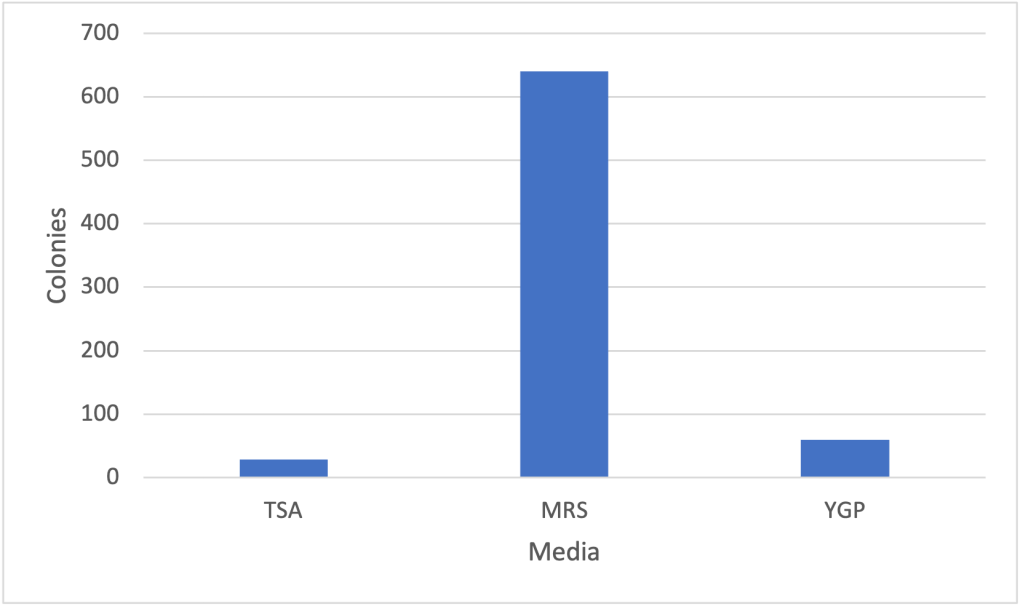
All samples had growth on TSA, but the only samples that had growth on MRS and YGP were from the GTs Pure kombucha. All dilutions of the GTs kombucha had similar proportions of growth across the media, so I’ve only included a graph for the 1:100 dilution. The media that grew the most colonies was MRS, showing that there was a high amount of lactic acid bacteria present in the sample (Figure 1). The growth on YGP shows that yeast was able to grow, and the growth on TSA shows that acetic acid bacteria were able to grow.
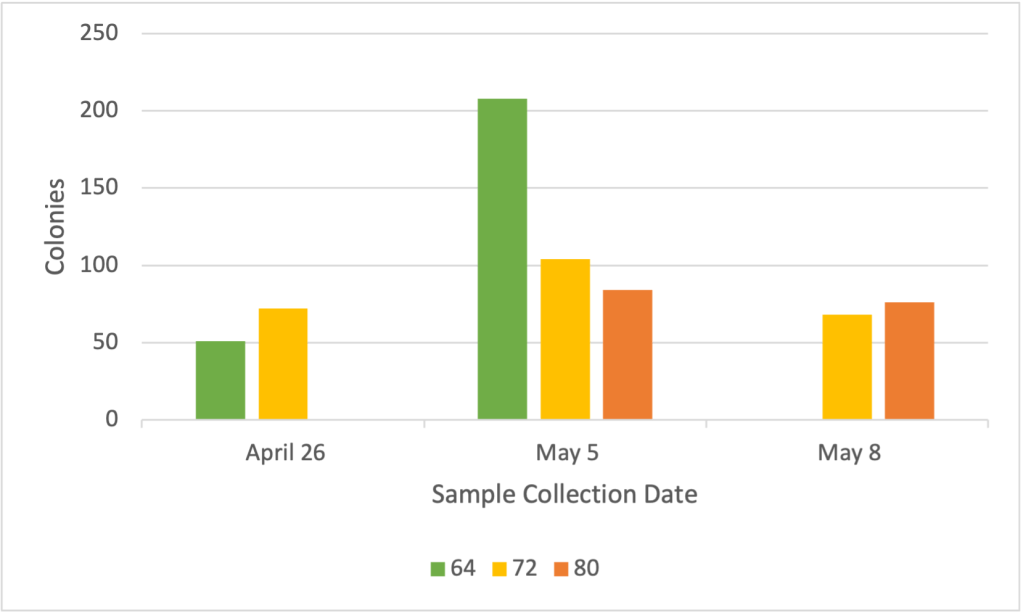
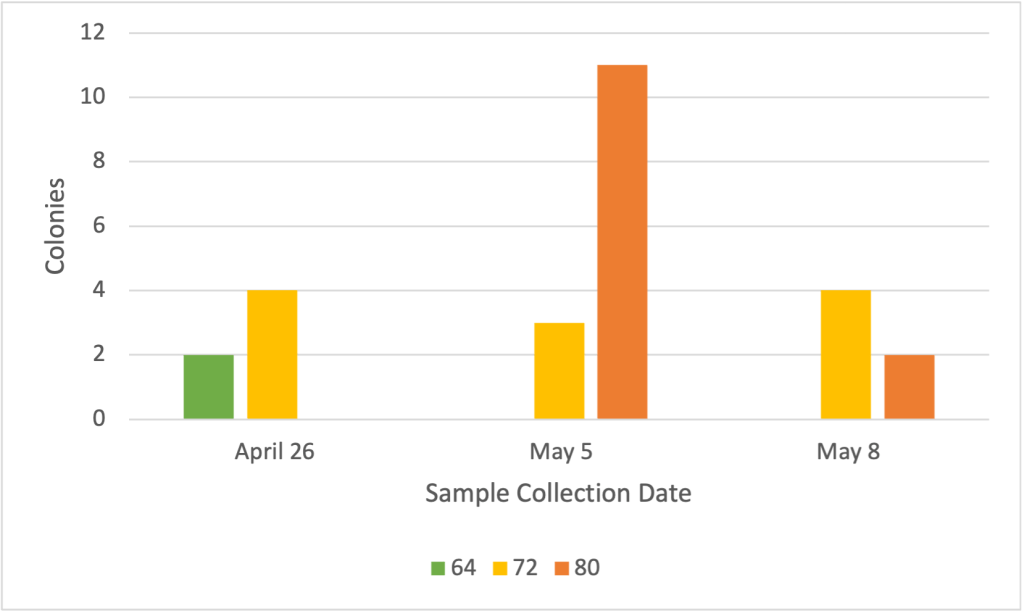
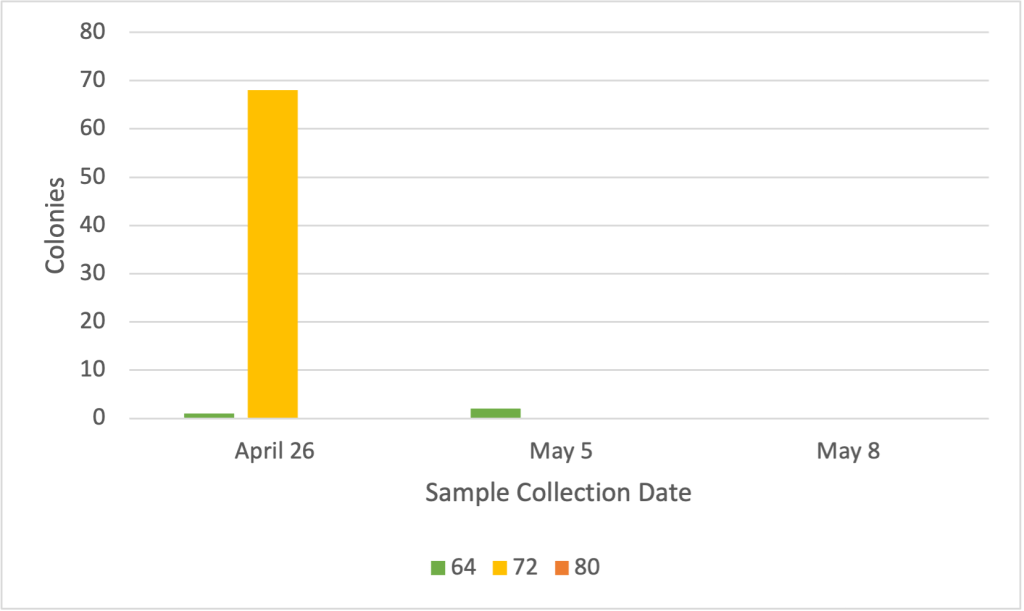
For all of the samples taken from the liquid of the SCOBYs, there was only growth on TSA. The growth across the dilutions was unexpected though, as there was more growth on the 1:1 and 1:1000, while there was very little growth on the 1:10 and 1:100 dilutions (Figures 2-5). This may be because these bacteria prefer a less acidic environment, and as the samples became more dilute, the samples and media became more neutral. Below are graphs showing the colony counts for each dilution, temperature, and date of sample collection.
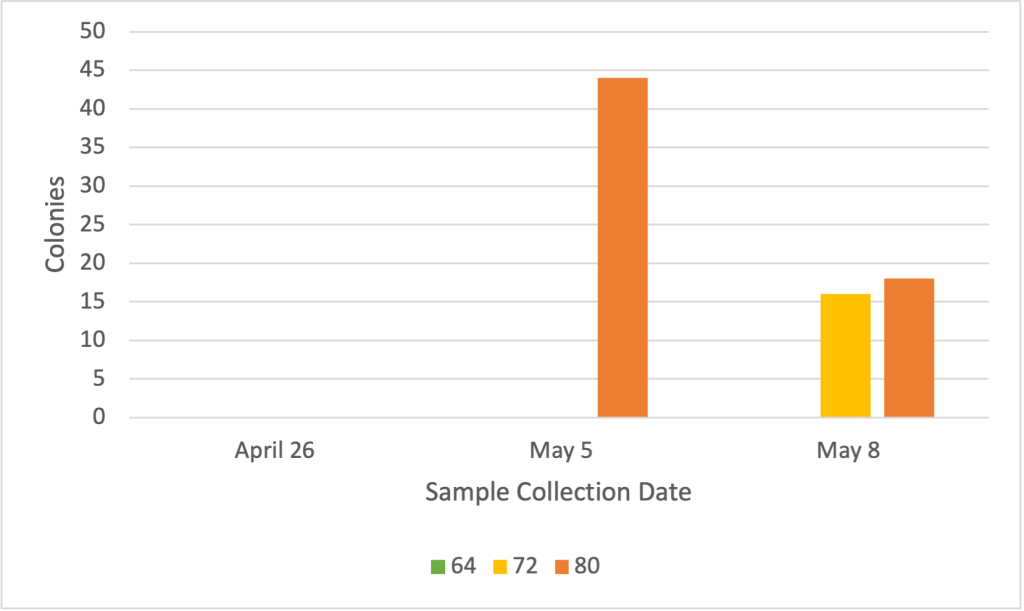
One reason that there might have been more growth from the GTs kombucha samples was that the bottle was shaken and degassed before the dilution, so all of the contents of the bottle were mixed. When taking samples from the SCOBYs that I grew, I did not mix the solution before taking samples. It’s likely that most of the bacteria and yeast were at the bottom of the solution, or in the SCOBY floating on top. and I took samples from just below the SCOBY.
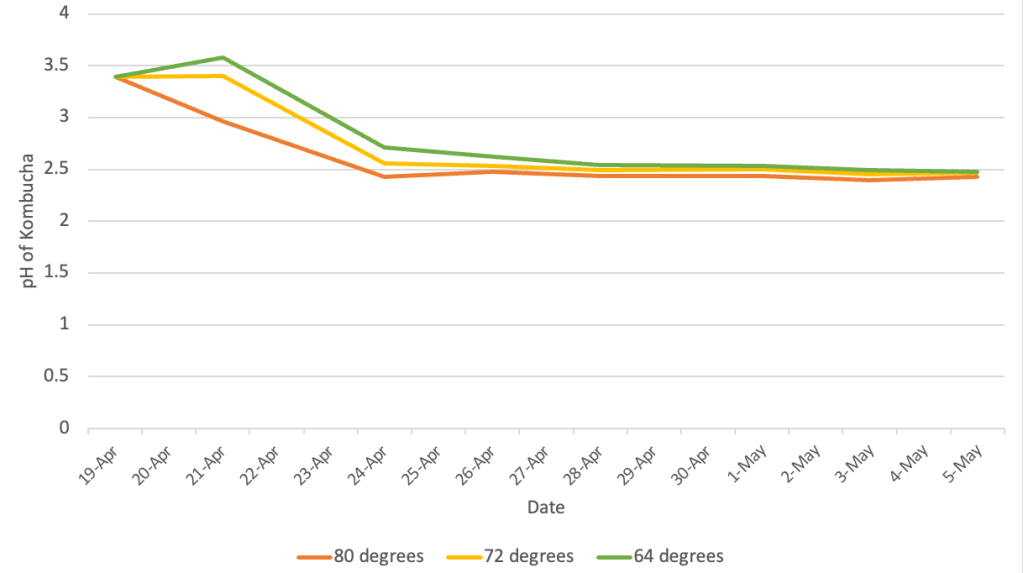
In the previous post I included the graph showing the pH changes of the SCOBYs over time, but I’ll also put it here for reference.
Conclusion
I believe that this was a successful preliminary experiment to look at the relationship between temperature and SCOBY growth as well as the microbial characteristics. There was no relationship between temperature and microbial growth, but there was an effect on pH. The pH of the SCOBY at 80 °F dropped much faster than the other two conditions (Figure 6).
I believe that if this experiment were performed again in the future, that the SCOBY solution should be mixed before being sampled, to try to include all of the microbiological aspects present in the solution. It would also be interesting to look at a larger range of temperatures, in addition to taking more samples over the course of the experiment. An experiment could also be done specifically looking at the growth of acetic and lactic acid across different dilutions to see if similar results are produced.
 CWU Craft Brewing