
Hi! I’m DJ Johnson, and this quarter I wanted to make mead. Last Spring, I made braggots (a beer/mead fusion) and during that process I experimented with The Mead Calculator from https://gotmead.com/blog/the-mead-calculator/ and noticed that it gave some interesting options for additional sugars. In fact, it had so many options that I wanted to test just how accurate it could possibly be.
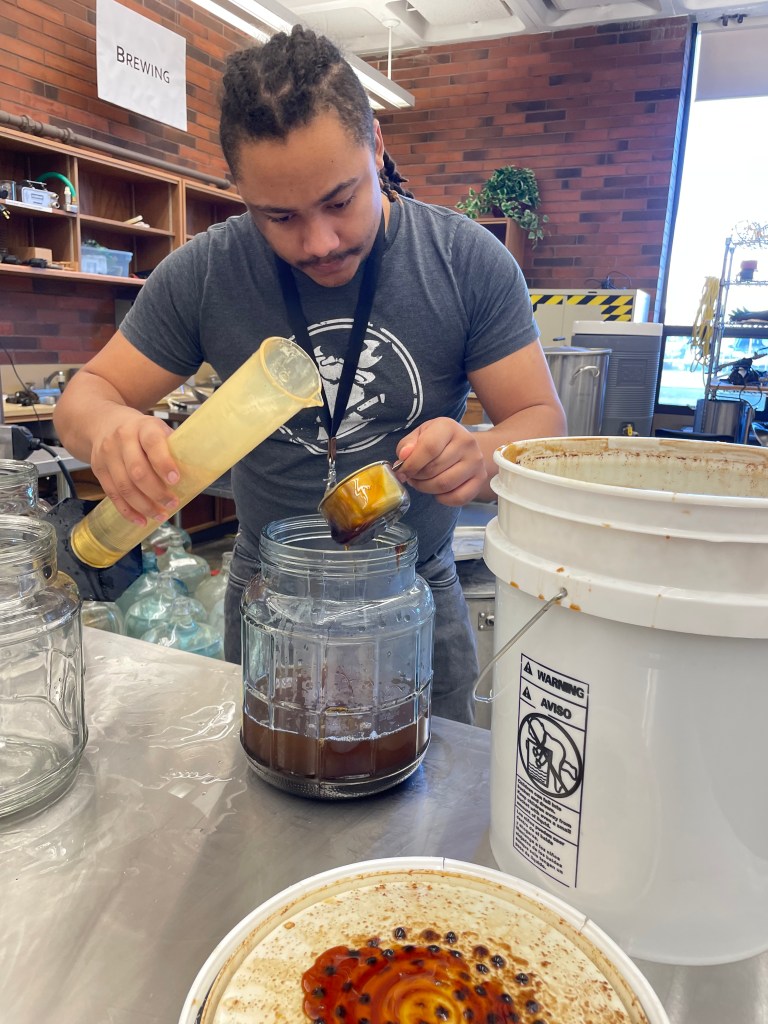
The calculator wasn’t exactly easy to use in my experience and additionally, it had so many options for additional sugars that I doubted it could be accurate on all of them, so I hypothesized that it likely wouldn’t be very accurate. The calculator has default sugar contents on all of the additional sugar options, but it doesn’t factor in the idea that sugar content can fluctuate or that people might be using concentrate for additional sugars. Since I decided to use concentrates (because the amount of fruit that I would have to use would be absurd) Brian and I had to run calculations to figure out the approximate sugar content for each of the additional sugars. Speaking of, we decided to go with one mead with just honey, one with apple concentrate, one with mango concentrate (which we ended up with significantly less than promised from our supplier), and one with tomato paste (with no added sugars or preservatives). During our brew day, we had to make some changes on the fly as we tried to determine different brix values of our ingredients to better calculate the estimated gravities.
I have some final insights, the main one being that the calculator isn’t exactly accurate, but it is decently consistent, with the initial calculations for SG being off by 0.009 for apple, 0.006 for mango, 0.011 for the honey control, and tomato was an outlier being off by 0.022 (however this could likely be because we could not determine the brix of the tomato paste to get a more accurate calculation). Overall this data is aligned with my hypothesis, meaning that this calculator can be useful for making mead, but should not be solely relied upon.
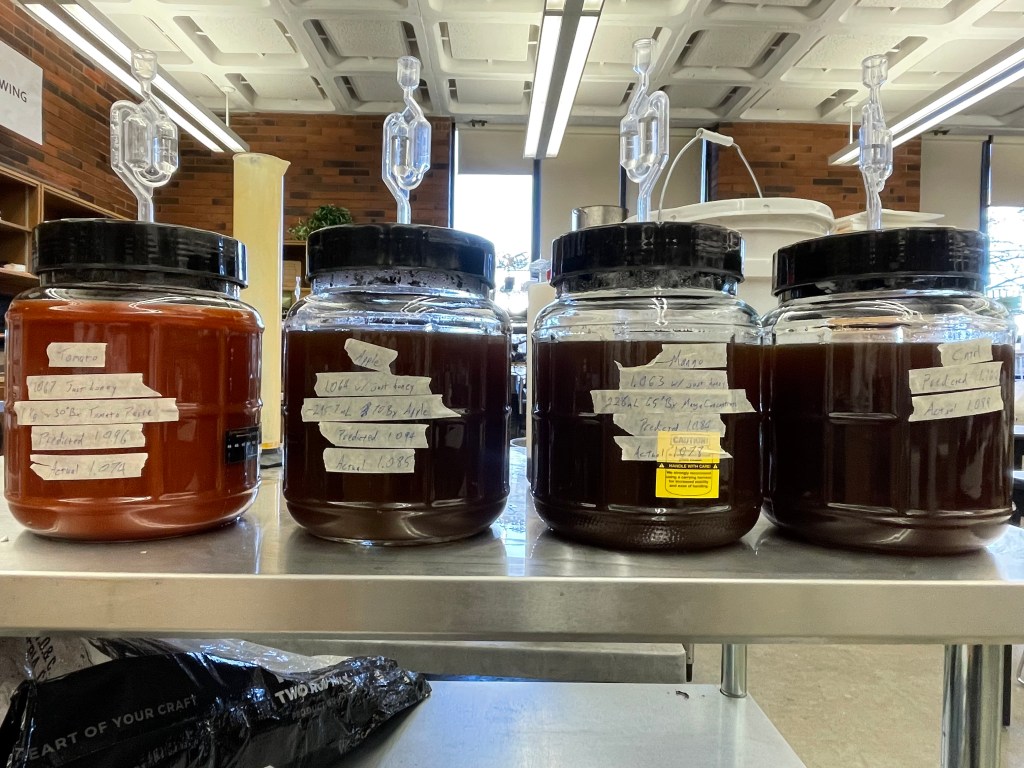
Some additional data to be considered beyond the experiment is that the control and the mango meads didn’t really take the yeast very well, but the tomato took it almost too well. Another thing to consider, the tomato had a white ring around the top of the must which I fear may be mold, which is strange because I’ve had worse conditions to make mead in and I’ve never encountered mold. This makes me think that there was something potentially wrong with the tomato paste but I’m not sure how or what.
Overall I really enjoyed this experiment! It gave me some recipe concepts that I’ll likely be trying sometime in the future!
 CWU Craft Brewing