
Objective and Hypothesis
The objective of the experiment was to isolate lactobacillus (LAB) cultures from store-bought yoghurt and see if they could be used in a beer. I hypothesized that I would be able to isolate at least three different mixed LAB cultures from different yogurts. Of the LABs that were isolated I predicted only one of them would be able to manage maltose to the degree that we could use it for a sour beer. I did not think that most of the cultures would survive in a maltose exclusive zone.
Methodology
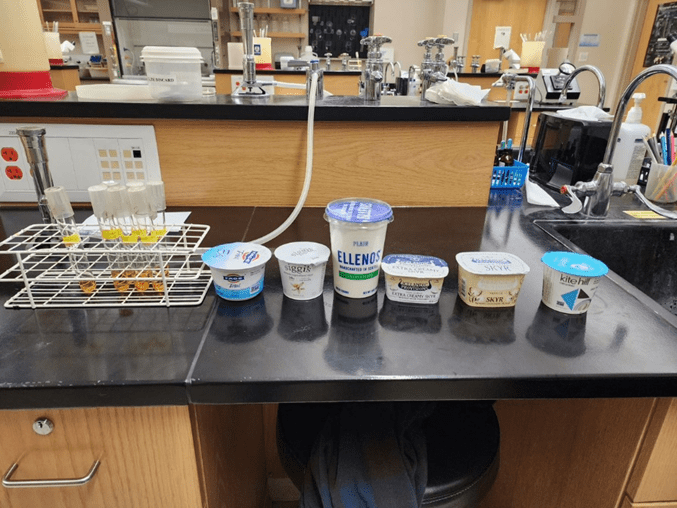
To test the hypothesis, I selected six yoghurts from Fred Meyers, prioritizing those that had little to no additional flavoring. I got Fage plain, Siggis vanilla, Ellenos plain, Icelandic Provisions Skyr both whole milk and vanilla, and finally Kite Hill. During each stage of inoculation, I followed the method of running a metal loop over fire, then waiting at least ten seconds after removing from heat before touching it to a sample, tube, or plate. This process was repeated for each individual sample, tube, and plate, ensuring no bacterial contamination.


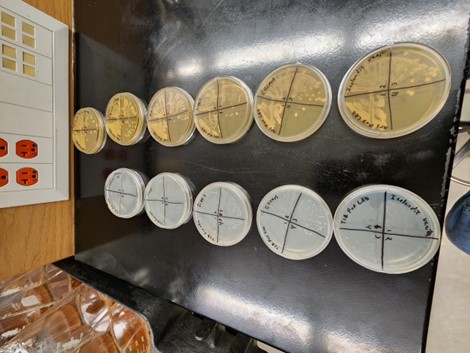
For the first stage I took a sample from each of sample and inoculated tubes of liquid MRS agar. We also inoculated a tube with a control that was later replaced with a different control due to lack of growth (new control: L. Brevis LP 672, 26). The goal of this was to grow the colonies before spreading onto dishes, thus avoiding spreading any other yoghurt byproducts that might be mistaken for colony growth. After 24 hours we had growth in all the tubes (except the original control, so we replaced it.) and after holding it on a shake plate we cleansed the tubes with CO2 before placing them in a candle chamber to remove any oxygen to stimulate further anerobic growth. After an additional 24 hours all seven tubes had better growth, so I plated them on MRS and TSA agars. Since each sample grew in liquid MRS we knew that they would grow on MRS plates. However, we chose to also plate on TSA in case any different colonies isolated on such plates performed differently in the final test. To plate I used the quadrant streak plate method, making a total of 14 plates. After growing for a week all 14 plates had some growth except for Icelandic Provisions Skyr whole milk TSA. It is of note that the MRS plates had significantly larger colonies than the TSA. Each sample, apart from the whole milk skyr TSA, was moved onto the next and final trial. A medium to large colony was selected from each plate and used to inoculate a tube filled with malt extract broth. This would test the ability of the LAB to survive and thrive in an environment consisting of mostly maltose, like that of beer wort. As a bonus, the malt extract broth started out as purple and would change color in response to a change in pH, indicating LAB growth. After another week of waiting the results were in.
Results and Conclusions
Each sample had been able to process maltose to a striking degree. We came to this conclusion because the color of the malt extract broth had changed from purple to shades of yellow. Each yoghurt LAB sample had turned a light shade of yellow, indicating a statistically significant drop in pH. However, the control, L. Brevis, had not yellowed as much as the rest, reaching a shade of yellow notably darker than the rest. These results lead me to the following conclusions. First, my hypothesis was wildly incorrect. I had expected only three samples to survive the final round of testing, and for only one of to reach a level to which I could use it in a beer. However, all the yoghurt samples seemed to process maltose better than the control sample that had been proven to work in sour beer. This leads me to my second conclusion. Either the method in the test was flawed or the original question was. I have a feeling that I asked for the meaning of life and got 42 for the answer. The question may not be can LAB found in yoghurt process maltose, but rather to what degree do we want it to. It may be that the yoghurt LAB samples would out compete yeast during kettle souring if not killed off before yeast inoculation.

The next step from here would be to use at least one of the yoghurt LAB samples in a beer to sour. While it is not realistic to make 13 different brews for testing, it may be wise to choose the sample based off aroma characteristics. While not part of this study I did notice that the Icelandic Provisions had some of the strongest pleasant aromas that persisted throughout the trials, where as the Fage had the weakest. It would be worth going ahead with two brews, one with the control LAB and another with the Icelandic LAB. If I was to conduct this next test, I would not ask cand the Icelandic LAB work, but rather to what extent. It may even be worth doing trials with different exposure times if the wort pH drops too fast.\


Experience & Knowledge Gained
While I did not meet the hypothesis in this experiment I was pleasantly surprised by the results. I am still a bit skeptical as to the validity of the experiment due to the failure of the first control sample. However, it may be that time in cold storage has made the first sample inert. The sample was not new to put it lightly. Overall, I had fun with the experiment. There were times it was like watching paint dry as I waited for my tools to cool between samples, but I was happy to see progress in all my samples. I also want to note that although my research question may have been wrong given the results, I do not regret asking it because it opened the door for a new question. One final note, I also learned that TSA kind of terrible at growing lactobacillus, at least compared to MRS.
 CWU Craft Brewing